
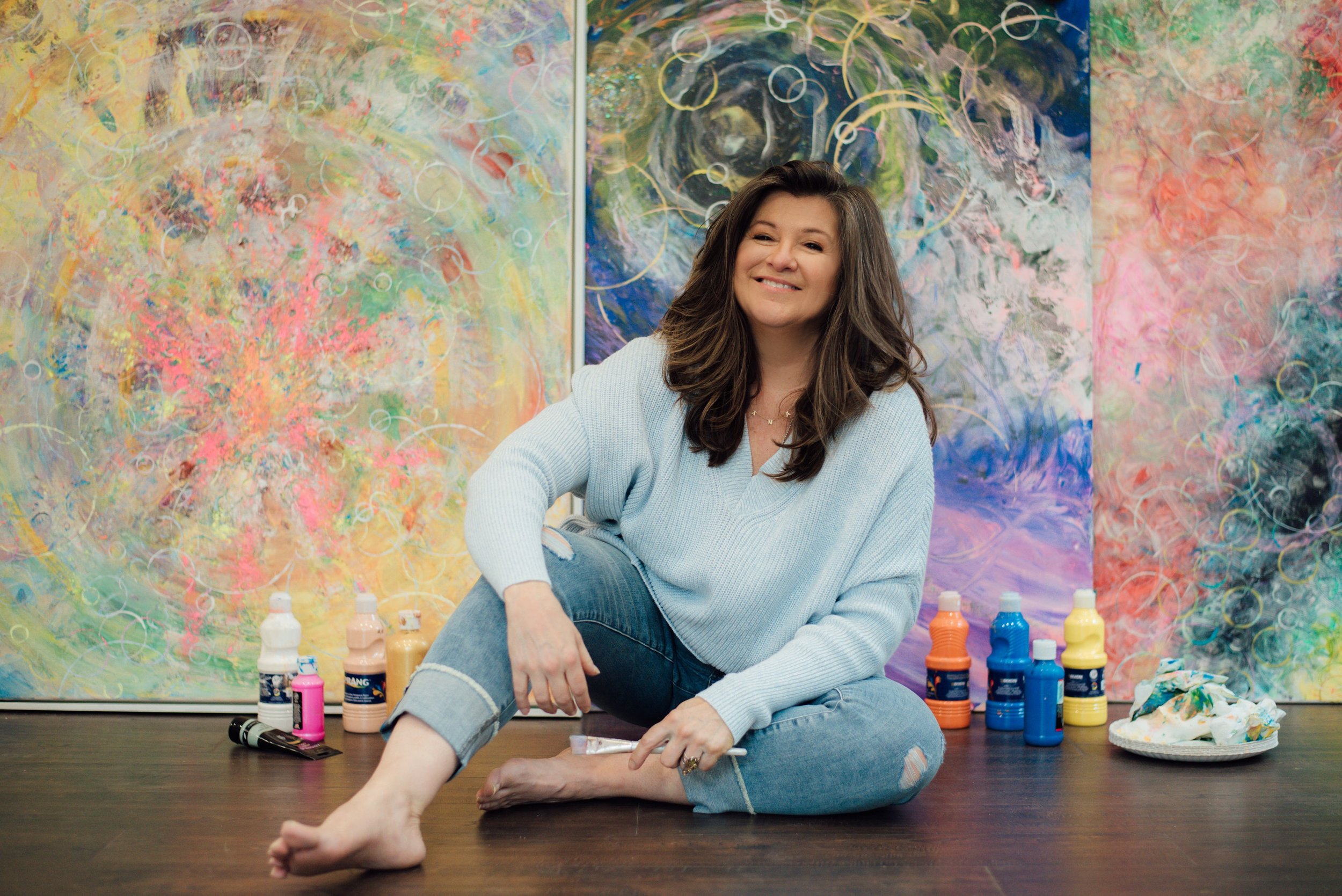
The Story of MetaArt and Ocular Meditation
For the person who wants to understand not just what MetaArt™ is — but what it does, why it works, and what becomes available when you enter it.
If you’ve found your way to this page, you already sense that MetaArt™ is something more than it appears. What follows is the deeper story: the neuroscience behind what happens when you sit with these paintings, the contemplative tradition from which Ocular Meditation™ emerges, the consciousness dimension that science is only beginning to find language for, and the practice itself.
The paintings are received, not designed. The MetaInsights™ transmission arrives before the first mark is made. You already know this. What you may not yet know is what actually happens in the brain and body when you encounter them — and why the experience so consistently exceeds expectations.
The NeuroArts of What Happens
NeuroArts is an emerging field that studies how aesthetic experiences, encounters with art, music, movement, and other creative modalities measurably change the brain, body, and behavior. What researchers in this field are discovering is what practitioners and viewers of MetaArt™ have been reporting for years: that looking at certain kinds of art does something specific and measurable to the nervous system.
Here is what current research and emerging evidence suggest about what happens when someone sits with a MetaArt™ painting:
The brain shifts into a more receptive state.
When the brain encounters complex imagery it cannot easily categorize, its habitual filtering system relaxes. This is the mechanism that normally tells us what we are seeing before we have finished looking. In that moment of suspended categorization, the brain becomes genuinely open to new perceptual experience. This is a recognized neurological mechanism, grounded in predictive processing theory, one of the most active areas of contemporary neuroscience.
An inward-looking network activates.
Research in neuroaesthetics suggests that deep aesthetic engagement activates the Default Mode Network, the brain’s system for self-reflection, introspection, and inner knowing. The paradox is precise: the more intently someone looks outward at a painting, the more the brain’s inward-looking capacity opens. Viewers often describe this as a painting that shows them something about themselves they could not quite reach before.
The body responds without being asked.
A direct visual pathway connects the eyes to the part of the brain that regulates stress hormones and autonomic nervous system function, bypassing conscious thought entirely. This means that what we look at is changing our body’s state, whether we are aware of it or not. Emerging research in embodied cognition suggests that aesthetic experience is not confined to the brain. It involves the whole body’s sensory and regulatory systems simultaneously. The nervous system settling that viewers consistently report during Ocular Meditation™ is not simply relaxation. It is a whole-body physiological response to sustained, receptive visual attention.
Brainwave states may shift toward calm.
Research suggests that sustained visual engagement with complex abstract imagery may induce brainwave states associated with deep meditation, calm, creative openness, and access to intuitive knowing. However, formal measurement of this in visual art contexts remains an active area of inquiry. These states arise in viewers without instruction, without effort, and without prior meditation experience.
A practice paper introducing MetaArt™ and Ocular Meditation™ is currently under peer review at Perspectives on Arts in Health. Researchers at the University of Virginia’s Division of Perceptual Studies have expressed interest in the practice. Lee Ann is a listed practitioner on the Neuroarts Resource Center, an initiative of the NeuroArts Blueprint in partnership with Johns Hopkins University.
What the NeuroArts field is beginning to measure, viewers of MetaArt™ have been experiencing for years. The science is catching up to the practice.
Selected research:
Vessel, E.A., Starr, G.G., & Rubin, N. (2012). The brain on art: intense aesthetic experience activates the default mode network. Frontiers in Human Neuroscience.
Chatterjee, A., & Vartanian, O. (2014). Neuroaesthetics. Trends in Cognitive Sciences, 18(7), 370-375.
Kaimal, G., Ray, K., & Muniz, J. (2016). Reduction of cortisol levels and participants’ responses following art making. Art Therapy, 33(2), 74-80.
Lutz, A., et al. (2008). Attention regulation and monitoring in meditation. Trends in Cognitive Sciences, 12(4), 163-169.
What Ocular Meditation™ is and Why It Works
Ocular Meditation™ is an eyes-open contemplative practice rooted in the yogic practice of Trataka, described in classical hatha yoga texts as a form of sustained visual concentration that bridges body-based and contemplative states. For thousands of years, contemplative traditions have understood what neuroscience is now beginning to measure: that the visual system is a direct pathway into altered states of awareness.
Unlike breath-based or closed-eye meditation, Ocular Meditation™ uses visual perception as the doorway. Viewers soften their gaze on a specific point within a MetaArt™ painting and sustain relaxed, open attention for an extended period. The practice requires no instruction, no prior experience, no verbal capacity, and no spiritual framework. There is nothing to understand. Nothing to interpret. Nothing to achieve. The painting meets you where you are, and organically something within you responds.
What participants share:
Perceived movement or dimensionality within static imagery
Rapid shifts into calm, focused, or expanded states of awareness
Spontaneous emotional release or clarification
A felt sense of resonance with one’s inner world
Access to non-verbal, intuitive, or imaginal cognition
Nervous system settling and deepened body awareness
Profound wisdom arriving without words
These experiences arise independently, across seasoned meditators and people who have never sat in contemplative practice, across children in sensory rooms and elders in end-of-life care, across clinicians and near-death experiencers, across those with deep spiritual frameworks and committed skeptics. The consistency across populations suggests something replicable. That is the research question now being formally investigated.
Where Consciousness Research and Neuroscience Converge
What the neuroaesthetics community measures and what the consciousness community experiences are not two different things. They are two languages describing the same territory.
When viewers sit with a MetaArt™ painting and report accessing something beyond ordinary thought, a quality of knowing that arrives without words, a felt sense of recognition, an encounter with something larger than the analytical self, they are describing what happens when the brain’s predictive filtering relaxes and the Default Mode Network opens. The experience feels mystical. The mechanism is neurological. Both are true simultaneously.
This is what it means to say MetaArt™ is not merely art. It is a bridge between what can be measured and what can be felt, between what science can explain and what experience already knows.
The answers are not outside. They were never outside. MetaArt™ and Ocular Meditation™ simply create the conditions for people to access what they already carry.
How to Practice Ocular Meditation
You can practice Ocular Meditation™ with any MetaArt™ painting, in person or on screen.
Find a comfortable position facing the painting.
Allow your gaze to soften and naturally find one point within the painting where your attention wants to rest.
Stay with that point. Not staring, simply resting your attention there with relaxed awareness.
When your mind wanders, return gently to the painting.
Allow whatever arises- movement, color shifts, emotion, stillness- without trying to interpret or hold onto it.
Stay as long as feels natural. Your gaze may feel drawn to another area. The key is to hold your gaze in the same place until you are guided elsewhere. Eleven minutes will take you somewhere unexpected.
The practice deepens over time. Each time you return to the same painting, you go further. Not because the painting changes, but because you do.
l

The Neuroscience & Biology Behind Meditating with MetaArt
Experience MetaArt by Lee Ann Heltzel — visionary art created for spiritual awakening, meditation, and higher consciousness — now featured by author and spiritual teacher Ray Catania, uniting the worlds of science, spirituality, and healing.

In this episode of The Afterlife Files, we explore the intersection of art, mindfulness, and well-being with Lee Ann Heltzel, the visionary behind MetaArt. Lee Ann shares how her automatic abstract paintings are more than just visual experiences—they transform spaces, shift perceptions, and foster emotional clarity and calm. Discover how her innovative approach to art redefines how we connect with our surroundings and learn about the profound impact visual experiences can have on mental and emotional health. Whether you're an art enthusiast or curious about the therapeutic power of creativity, this episode will inspire and uplift you.
Ocular Meditations with personal commissioned MetaArt deeply engages a person to their own higher self where pure magic unfolds.
Lee Ann explains MetaArt with a 10-minute Ocular Meditation:
Fully Realized Self
Heal
Love